Behind the Book: Napalm Hearts

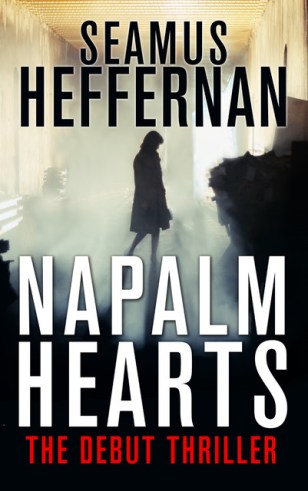
NapalmHeartsCover


Today I’m joined by author Seamus Heffernan to discuss his debut novel about an American private detective looking for a missing woman in London.

When I first read about this new book I was instantly taken by the fact that it’s set in London, and when I discovered the author had lived in my favourite city for several years I was interested to find out his inspiration and old haunts.

Everyone’s experience of London is so individual – I never get tired of talking about it…..

Tell us the basic premise of your book.

It’s a detective story about an American PI working in London. He is making a decent living working infidelity cases but is pretty bored, so when (trope alert) a rich and powerful client hires him to find his missing trophy wife, he jumps at the chance. From there, the necessary twists and (occasionally violent) complications ensue.

It’s a mystery story, and while I certainly wouldn’t describe it as high literary art, it is a book that explores some tough themes: Loneliness, class, love, sex and loyalty. The protagonist, Thaddeus Grayle, never really fits in. He’s an American navigating life in a strange land, and then takes a case that plunges him into a part of his adopted city he has never seen before. For him, the story is about being an outsider in worlds you don’t really understand.

What made you choose the locations you use in London and do they have any personal significance for you?

Oh God, yes. I spent five years in London and loved it. I grew up in a pretty small place and since I was a kid I wanted to travel and live in a massive city. London was perfect—it’s truly a world capital and there are only a handful of those on the planet, so I felt pretty fortunate to be there.

That said, the end of my time there was tough. My marriage broke up and I went through a pretty long period of loneliness and self-doubt. There’s nothing worse than feeling alone in a massive city—I adored London but I could feel the city and its temptations swallowing me up whole. I moved back to my hometown of St. John’s, Newfoundland, for a hard life reboot and I’m pretty sure it saved me.

A few years after relocating, I started knocking around ideas for a book and my narrator needed a voice. I could hear my own loss and that awful sense of urban isolation creeping into his, and decided to stop fighting it and let it happen.

The book looks at the underbelly of the city – where did you take inspiration from for the darker side of London?

Too many long nights in too many dive bars.

I’m pretty sure a fair few Londoners can relate to that…..What made you want to become a writer?

I don’t know if anyone “decides” to become a writer—you either want to do it or you don’t. That said, I had always been a pretty decent professional hack, hence having worked in marketing and communications for a long time. But fiction was always my goal. Eventually I just stopped making excuses not to do it, and started getting more serious about it.

Do you have a favourite author?

For sure, but I think it’s safer (and more fun) to list a few that have stuck with me through the years. Outside of crime fiction, some modern writers I like include Bret Easton Ellis, Douglas Coupland, Michel Faber and Lee K. Abbott. Raymond Carver and Anton Chekhov for the classic short stuff. I used to be heavy into comic books and find Brian Michael Bendis and Warren Ellis interesting.

Within the genre: Ian Rankin, Richard Price and Dennis Lehane. Finally, any of us who dare put “crime fiction writer” anywhere near a résumé must willingly genuflect to Chandler and Hammet, of course. And they totally deserve it.

Which famous people (alive or dead) would you most like to have a few drinks with?

OK, I’m going to cheat a bit here and force myself to not pick any writers.

My background is in criminology, so I would enjoy chatting with Fred Abberline and John Douglas. Abberline was the lead investigator for the Jack the Ripper murders and Douglas pioneered psychological profiling for the FBI, so I imagine they’d have a lot to talk about.

I’m also a sports fan, so I would ask Dennis Bergkamp (former Arsenal footballer) and Bob Gibson (former pitcher for the St. Louis Cardinals) to hang out sometime. They were both geniuses in their respective games, but also delightfully cranky.

Finally, I’m really fascinated by people’s creative processes and how they make what they make, so I’d love to just be able to sit in on the recording of one of my favourite albums and talk to the musicians and producers involved. I’d spin a wheel and land somewhere between Miles Davis’ Kind of Blue and Big Black’s Atomized.

What are you working on next?
In no particular order:
• The follow-up to NAPALM HEARTS.
• A TV pilot script, a dramedy about the day-to-day grind of working in government from the point of view of the people who serve the public every day. A somewhat kinder, gentler The Thick of It, perhaps.
• Meeting agents.
• Getting by with a little more exercise and a little less sleep.

Huge thanks to Seamus for stopping by, I’m really enjoying the book so hopefully a review to follow if I can tear myself away from house renovations….

You can (you should) order Napalm Hearts here

And get in touch with Seamus here –

Official Website

Facebook

Twitter

Crooked Cat Books

Instagram

About the Author;
Prior to his writing career, Seamus Heffernan worked in education, journalism, marketing and politics. He currently works for a Member of Parliament. Born in St. John’s, Newfoundland, he has called several places home, including a lengthy stint in London, England. He presently resides in British Columbia, where he splits his time between Abbotsford, Mission and Vancouver.
His short fiction has previously appeared in The Raspberry and Louden Singletree. NAPALM HEARTS is his first book.

Behind the Book – Topaz Eyes

new TE(1)


It gives me great pleasure to welcome the the lovely Nancy Jardine to my blog today. Her book Topaz Eyes caught my eye and I wanted to get the background inspiration for such an amazing adventure!


Welcome  Nancy, thank you so much for taking the time to chat with me!

Hello, Anne-Marie. Thank you for the opportunity to visit your blog. I aim to ‘get out’ a lot more this year so your invitation is much appreciated!


Tell us the basic premise of your novel?

Topaz Eyes has been called a ‘fabulously dangerous quest for a precious collection of emerald jewellery’ that once belonged to a Mughal Emperor. It’s also been called ‘ a deep plot of intrigue across Europe’ and beyond. The novel centres on a fictitious European family of third generation cousins. In their hunt for hugely expensive missing jewellery that the family once owned, some cousins are nice but others are downright nasty, even murderous.

Why did you choose the locations you chose and do they hold any real life significance to you?

All are personally significant in some form. The story begins in the beautiful university town of Heidelberg, Germany, chosen because my daughter spent a year at the university and I visited her there. Keira Drummond, my main female character, also spent time at Heidelberg University – isn’t that an amazing coincidence (*wink, wink*)? Some of the action takes place in Amsterdam, Holland, because I lived in Holland for three years and adore the country. I won’t give away any spoilers but one of the complex relationships in the story mirrors a situation I found myself in when I lived in Holland. Vienna features just because it’s a fabulous place to be a tourist. I decided that one cousin had to be American so I used locations in Minnesota, USA, which I’ve also been to. Keira Drummond is an Edinburgh lass because I wanted a ‘Scottish’ element in the story.

What inspired this exciting adventurous novel?

Topaz Eyes is my second contemporary mystery that revolves around an ancestral theme. The first ‘Family Tree’ I invented for my mystery Monogamy Twist  was a fairly simple one but when I started Topaz Eyes I  wanted to create a much deeper mystery with a bigger cast of related characters who had a common purpose linking them together. I then had to think up an exceptionally absorbing reason for a bunch of third generation cousins to be on a murderous quest, family members who are essentially all strangers at the outset of the novel. The 1880s matriarch of the family is from an Amsterdam family who own a prestigious jewellery business. This meant I could have lots of contemporary action happen in different worldwide locations since her descendants end up scattered around after the Second World War. I mainly used my memories of the locations which meant only some up-to-date fact checking was necessary. I remember having a lot of laughs when I was creating the family tree and the incidents that happen in the story!

Did it take a lot of research to come up with the story behind the jewellery once owned by a Mughal Emperor?

My main research for this novel was about emerald collections, especially those originally owned by Mughal emperors. I’m fascinated that a piece of jewellery designed for a Mughal Emperor in 1580, 1680 or even 1780, could be completely different by 1880! I hadn’t really appreciated that designs created for a particular woman (wife or one of the many concubines) were rarely appropriate for another woman and that it was commonplace for the gems to be reset into new jewellery. That cemented a really deep mystery because if you don’t have many clues about what an item might currently look like, then how difficult is it to bring that collection together? Topaz Eyes ended up being a mystery within a mystery but you’ll have to read the story to uncover that connection!


If you could go on a global adventure with anyone (alive or dead) who would you choose?

I’m cheating here because although I write contemporary mysteries, I also write historical fiction. In Book 4 of my Celtic Fervour Series (unpublished), my main characters are mainly Celtic but there’s also General Gnaeus Julius Agricola. Agricola was the commander of the Ancient Roman army which marched all the way to north east Scotland in c. A.D. 84 and then they left without properly absorbing the area into the Ancient Roman Empire! The only reason we know this happened is because Agricola’s son-in-law – Cornelius Tacitus – wrote about Agricola’s military campaigns. I’d love to journey back to c. A.D. 95 and spend time in Rome because that’s probably when Tacitus was writing about Agricola’s exploits in northern Britannia (The Agricola was published in A.D. 96). That way I might get the true version of what happened! And…I’d love to describe to  Tacitus what Rome is like today having visited there in 2016.

What are you working on next?

The big plan is to have Book 4 of my Celtic Fervour Series published in the spring (2018). After that I’ve got two projects already started that need a lot of work. The first is Book 2 of my Rubidium Time Travel Series- a Victorian adventure. The second is a family saga that begins in Scotland c. 1850 – Book 1 (of 3?) being another Victorian setting. Then in the fullness of time I’ll get back to Book 5 of my Celtic Fervour series…or maybe I should write that next? Who knows (**smiley face here**)


Nancy Jardine is a member of the Romantic Novelists Association, the Scottish Association of Writers, the Federation of Writers Scotland and the Historical Novel Society. She’s published by Crooked Cat Books and has delved into self publishing.


You can find her at these places:

Blog: http://nancyjardine.blogspot.co.uk  Website: www.nancyjardineauthor.com/

Facebook: http://on.fb.me/XeQdkG & http://on.fb.me/1Kaeh5G

email: nan_jar@btinternet.com  Twitter https://twitter.com/nansjar

Amazon Author page http://viewauthor.at/mybooksandnewspagehere

Goodreads https://www.goodreads.com/author/show/5139590.Nancy_Jardine


Behind the Book – Hunter’s Chase

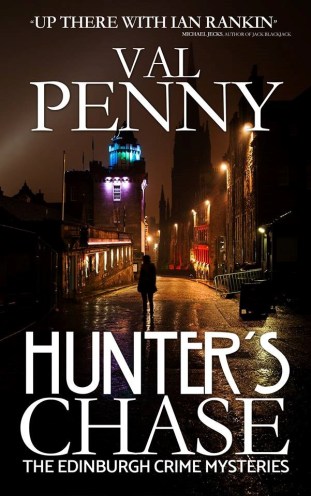
HUnters Chase cover


This week I am delighted to welcome author Val Penny to my blog. Her Edinburgh based crime novel Hunter’s Chase is due out through Crooked Cat Books on 2nd February 2018.

I am a lover of crime fiction, from Jo Nesbo to Patricia Cornwall and Agatha Christie to Arthur Conan Doyle, my love of sleuthing has been firmly set from a young age (I blame my parents!) I grew up in a busy household full of brothers and sisters who also loved to read crime fiction and I would always grab what they had finished with. The Detective is always the greatest character (followed closely by their nemesis) and I always love the development of their personality and how they solve the crime in question.

So naturally when I heard about Hunter’s Chase and found I had the opportunity to ask a few questions I jumped at the chance!


Tell us the basic premise of your novel?


Hunter by name, Hunter by nature: in Hunter’s Chase, Detective Inspector Hunter Wilson struggles to ensure the crime in Edinburgh does not go unpunished. Hunter’s Chase introduces a new detective, DI Hunter Wilson into Tartan Noire.

I think all crime novels explore the triumph of good over evil. The readers know the criminals will not succeed. Still, the thrill of the chase and the problems overcome to achieve justice for the victims must enthral and satisfy the readers.


Did you take any inspiration from any real life crimes? 

I did not refer to any specific real life crimes but I did want to explore power and politics. Also, as I have a large family, the importance and problems caused by family ties is interesting to me.

Big cities all have issues with illegal drug use. One of the hidden problems is the risk to the health and security by people who are functioning drug abusers, who may continue to study or hold down challenging jobs. I find this both confusing and fascinating.


Is your lead character, DI Hunter Wilson inspired by anyone?

Hunter Wilson, like all my characters in Hunter’s Chase, is a combination of several people that I have found interesting. I needed my main protagonist to have certain characteristics including patience, perseverance and a desire to achieve justice for those who could not attain that for themselves. Hunter is a compassionate man who fights for the underdog and is a fine team player. These are important qualities in my main character.

But I also needed Hunter to have flaws. Everybody has faults and to make Hunter believable, he had to have them too. He is not a saint. He is divorced, he is untidy, he likes to win, he bears a grudge.


Why did you choose the setting of Edinburgh and do the locations hold any real life significance to you?

Although I am originally from California, USA, I lived in Edinburgh, Scotland for many years, so it is a city I know well. I chose Edinburgh as the setting for Hunter’s Chase because it is a beautiful, multi-cultural city which is well-known and loved around the world. Edinburgh is a big enough city for any problem that Hunter needs to solve to plausibly have taken place. Nevertheless, because it is a city of only half a million people, in many ways it is like a big village: there is a feeling that everybody knows everybody else. That is an amusing conceit when I am writing.


Did it take a lot of research for your locations and story line, how did you research the police work?

I did need to do a lot of research for Hunter’s Chase. I was surprised by how much I enjoyed that.

When I was choosing places for action to take place in my novel, I needed to check that what I was asking of my characters could actually happen. That was fun. Revisiting and exploring again the beautiful city of Edinburgh is always a joy.

Also, you will not be surprised to know that I do not have first-hand knowledge of drug trafficking! I found the research for that quite exciting: of course it was all theoretical research.

I had to research the roles of Crime Scene Investigators too and received a great deal of assistance with that from my friend Kate Bendelow. Her book, The Real CSI: A Forensic Handbook for Crime Writers, is indispensable. I was also lucky to have good support when I was researching police procedures. This came from former Detective Chief Inspector Stuart Gibbon. His book, The Crime Writers’ Casebook is invaluable to those writing historical or modern day crime stories.


What are you working on next?

I am presently working on the sequel to Hunter’s Chase –  Hunter’s Revenge. My publishers, Crooked Cat Books, have just confirmed that it will be published in August/September 2018, so I better get a move on and finish it.

Hunters Chase will be released through Crooked Cat Books on 2nd February 2018, pre order your copy here

You can keep up with whats happening with Val on the following links;


Val Penny Website

Val on Facebook

Friends of Hunter’s Chase Facebook Group

Val on Twitter

Val at Crooked Cat Books

Behind the Book : The Girl in the Gallery

Girl in the Gallery

I was drawn to this book by Alice Castle as I was aware that it was set in Dulwich, as was her last book ‘Death in Dulwich’. Being as I used to frequent the area when I lived in Peckham I was instantly snared, I love reading books set in London as I find it so much easier to get into stories when I know the setting well. London and a murder mystery – my ideal book – lucky for me Alice agreed to discuss her book ahead of its release on 19th December.

Tell us what your latest book is about

Hi Anne-Marie, thanks so much for hosting me! My latest book, The Girl in the Gallery, is a cozy crime murder mystery with a dash of romance. It’s set in the very beautiful Dulwich Picture Gallery, open to the public for 200 years this year. The book opens when my single mum amateur sleuth, Beth Haldane, stumbles on a terrifying new exhibit when she pops into the gallery before work. It’s the second in my London Murder Mysteries series, the first, Death in Dulwich, was published earlier this year, but you can read either as stand alone stories.


Did anything specific inspire the storyline?

My storyline is inspired by Dulwich Picture Gallery itself – it’s stuffed with amazing art, and the building itself is very unusual. At its heart is a mausoleum, containing the dead bodies of the original collectors in marble coffins, on display to the public. Weird and quite creepy! I have always thought it would be a brilliant location for a murder mystery.


Tell us more about Dulwich and any other London locations you use, do they hold meaning?

I love Dulwich. I lived there for four years, after returning from nearly a decade in Belgium. I found the area, and the people, really welcoming. I am repaying them by setting a series of grisly murders in their midst, which I really hope they won’t take the wrong way. It is a perfect, village-like setting, where people know everything about each other – or think they do. It’s a modern St Mary Mead, the place where Agatha Christie’s Miss Marple solved unspeakable crimes. I was really thrilled when a reviewer of my first book in the series, Death in Dulwich, said my heroine Beth Haldane was a modern Miss Marple. I’m planning to venture away from Dulwich with other books in the series but, like Beth, I will always have a soft spot for SE21.


Do you have a favourite author?

I have loads – Agatha Christie, of course, then Dorothy L Sayers, Margery Allingham, Ngaio Marsh, PD James, Ruth Rendell, Val McDermid, MC Beaton, Simon Brett… the list goes on. I love whodunits! I do read other books, I’m in a book group and I plod through whatever’s chosen, but I always come back to a nice murder mystery in the end.


What made you want to be a writer?

A teacher at my infants’ school. I can’t even remember her name, but she very kindly praised a sentence I’d written and I thought to myself, ‘this is something I can do.’ Good teachers are so wonderful and not nearly treasured enough.


If you could have a night of drinks and literary discussion with any writers (alive or dead) who would you choose?

Oh, I think Dorothy Parker would be a must, and then Shakespeare might be fun, Jane Austen of course… I think that lot might be daunting enough! I’m sure I wouldn’t open my mouth in that august company, but I’d be taking notes for my next novel, that’s for sure.


Will there be a 3rd instalment for Beth Haldane to solve?

There definitely will be a next installment, I am writing it now. It’s called Calamity in Camberwell and this time, Beth is on the trail of a missing friend, with plenty of obstacles thrown in her way. And she’s giving online dating a try! I’m hoping it will be out by mid-2018. After that, there’ll be plenty more mysteries to solve, if I have my way.


Get yourself over to Amazon now and pre-order The Girl in the Gallery here!

While you are there, grab the first Beth Haldene mystery Death in Dulwich

Alice

Alice Castle

MyBook.to/GirlintheGallery

MyBook.to/1DeathinDulwich

Facebook

Blog: DD’s Diary

Twitter: @DDsDiary


About London

There’s this idea that people should know the very moment when they fall in love, that for some reason there would be a moment, ‘stars would explode in the sky’ as Nick Cave put it. But they don’t, there is no epic firework display, the earth continues to turn and nobody else on earth knows it has happened. That’s why you forget the precise moment.

I don’t recall the moment I knew I was in love with London; I think it had built slowly over the years. But I feel it more clearly now, every morning when my bus turns out onto London bridge and suddenly the sides fall away, I am over the river and I can see the city laid out before me, Tower Bridge to my right, St Pauls to my left, and everything in-between and I catch a breath, my heart swells and I feel it. Love.

Image

I grew up out on the coast in south east Essex, an idyllic childhood of parks and playgrounds and trips to the beach after school. I used to walk home from school sometimes along the seafront, even in winter just to feel the biting air and feel alive again after a day of dusty brained learning and stuffy classrooms. I knew I was lucky to grow up there, 45 minutes train ride from London and blessed with fresh air and man-made beaches.

When I was younger, my parents used to take me to London once a year during the October half term holidays. It was so busy and lively and the shops sold things I didn’t see back home, bookshops there were palaces of literature laid out on several floors where I would lose whole afternoons in the poetry section.

I always longed to visit Whitechapel due to my interest in creepy tales of Jack the Ripper but it remained a mysterious tube station that we never got off at. As far as I was concerned it was all still dark alleys and Victorian street urchins up there.  As an older teenager I visited Camden with friends and felt at home in all the alternative shops and market stalls, although always slightly nervous of the enormity of it, days out would end with a tired scuttle back to Fenchurch Street and what felt like the longest train journey ever.

In my 20’s I visited a few more times, going to gigs mainly, staying over in hotels occasionally, but I still felt so removed from it all, like it was all behind glass and I was just there as visitor in a giant museum.

When I was 29 I went to Brick Lane for the first time and I loved it, shortly after some of my friends moved to Whitechapel so I started going up more regularly, finally getting off the tube at that mysterious station. The first time I went up on my own felt weird, I was going to places I had never been before and instead of that feeling of distance, I was starting to feel at home.

ImageThe day after my 30th birthday I went on a date with the man I eventually married. We met up at Fenchurch Street and spent the whole day walking around, along the Southbank and back into the city where we wandered down alleyways and found hidden churches, gargoyles and streets empty of life. He showed me a part of London I had never seen before. The City of London is a different place on a Sunday compared to the weekdays when people pour in and out of the skyscrapers and fill in all the gaps between the buildings. At the weekend all that remains is quiet corners, old buildings and new building living side by side quite peacefully, endless amounts of closed branches of Starbucks and Eat that have no purpose without the city workers that fill them during the week days.

I think maybe I fell in love twice that day. With the man I had just met and with the city I had just been shown.

I left my life by the coast and got a job in North London, soon after I moved to South London. I had never lived anywhere other than where I grew up but it felt right, like it was time for me to move on.

ImageI have lived in London for 4 years now, and I never ever get tired of it; my journey to work takes me from the foot of the Shard, past Southwark Cathedral, past Monument, up Bishopsgate, past the Gherkin and the Heron, through Shoreditch and to Hackney. Every morning I look out from the bus as though it’s all still new to me, it’s all still so beautiful to me.

At weekends we take long walks, to Brick Lane and Spitalfields, along the Southbank to Westminster or over to the back streets of Covent Garden and Soho. The difference for me now is that I don’t feel distant anymore, that I belong and I am part of it. Even though my awe still allows that feeling of visiting a giant museum, I feel now that instead of being behind glass I can touch the exhibits and even wander around back rooms not open to the public.

I take photographs incessantly like a day-tripper, I go to an endless supply of art and photography exhibitions, I wander back streets looking for street art and I say a prayer every time I have to brave Oxford Street. I know I won’t live here forever, for one reason or another I will end up by the coast again one day, so while I am here and its all on my doorstep I want to see as much as I can.

Image

This summer in London has been wonderful, the energy and excitement around the Olympics was inspiring; for all our pre-Olympic moaning about stupid mascots, transport and other problems we all got swept away by the ridiculously happy vibe that was created once we started winning gold medals. The transport system ran fine, people talked to each other, we hugged ugly Wenlock and Mandeville statues around town.

London fell in love with itself.

I have so much to say about London, but the rest can wait.


(All Photo’s Copyright of the author)